What an assistant coach at a Division 1 programme actually looks at
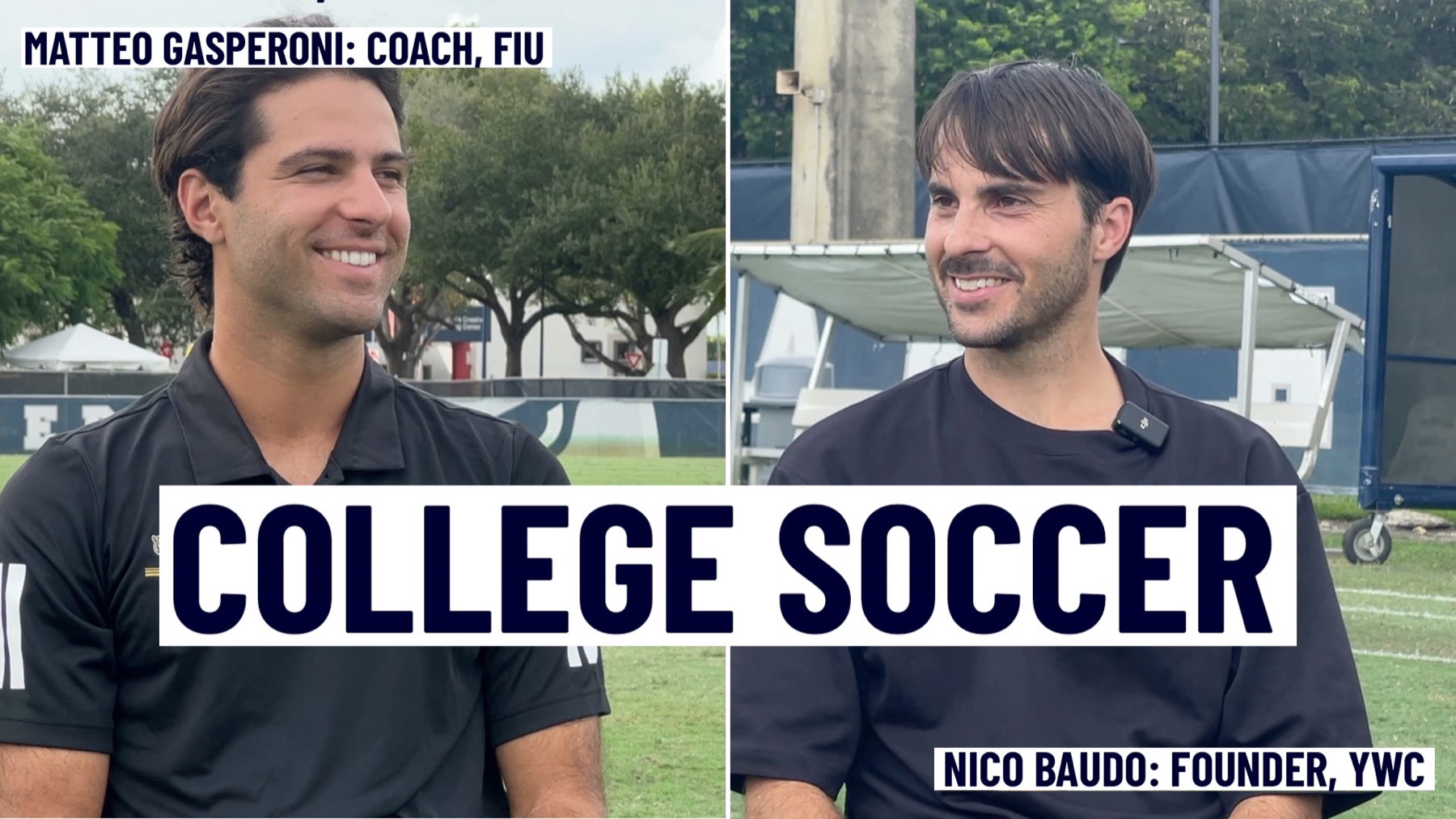
Matteo Gasperoni is an assistant coach with the men’s soccer programme at Florida International University in Miami. He is also, not long ago, exactly the player reading this: an Italian who arrived in the United States on a second chance, after his career at home fell apart.
That combination is why this interview is worth your time. He is unusually specific about the part nobody explains — which emails he opens, why a recommendation only buys a first look, what makes him get on a plane to watch someone in person, and what a red flag sounds like in conversation.
Who he is
Ten years at Cesena, his hometown club, through the Under-19s. Then Atalanta — which he calls the best academy in Italy — six months with the first team, a place on the bench for Serie A matches, and Italy caps at Under-16 and Under-17.
Then it fell apart. Injuries, a return to Cesena in the second division, and the club’s bankruptcy in 2018 cost him his contract. He went to university in Italy, graduated, and moved to the United States: two seasons at FIU with trophies — “the best time of my life” — and a final year of eligibility at San Diego, winning that conference too.
He did not plan to coach. He took a master’s in human resources management, then studied business analytics at San Diego and joined the staff there as a data analyst on an internship. Coaching grew out of it. Coach Kyle brought him back to FIU in 2024, and he was promoted to assistant coach in March.
What happens to your highlight reel
He receives highlight videos every day, and he says plainly that he cannot watch them all. What gets a player looked at is a recommendation from someone he trusts — an agency or a scout with a track record.
And he rates the sources that tell him what is wrong with a player.
“I have a lot of agents that tell me, oh this guy is amazing, he’s amazing, he’s amazing. But I want to know his areas of improvement.”
A recommendation buys attention, not a place
“I don’t take a player because of a recommendation.”
He watches multiple full matches, not edits. He researches where the player comes from, his injury history, whether he bounced back, whether he is playing now. When he can, he travels — FIU sends him abroad — because watching live and speaking face to face tells him things video cannot.
Two players who show the method
Leonardo came from a Division 2 side that had not won a single game the previous season. Almost nobody would look at that profile. Watching the tape, Gasperoni saw a 19-year-old in his first year in the United States, still working both phases and still talking to his teammates while his team was losing 3-0. A leader on a team that always lost.
Pasquale came out of the Italian amateur divisions, a level most coaches skip entirely. Gasperoni watched his video, spoke with him several times, worked out why he had not moved up, and saw the ceiling. Four goals and three assists early in the season.
The red flag
He says he can tell in conversation when a player is not genuinely invested in the project — and that outweighs a strong résumé.
“I prefer a player that has a slightly lower résumé but wants to come here and give 110% from day one.”
A plus, not a requirement: experience in men’s football. College soccer gives new arrivals roughly two weeks in the fall before the season opens, so players used to senior-level demands adapt faster.
Age, and the way in
The transfer rules have pushed the average age in Division 1 up, and Gasperoni does not pretend otherwise. He looks at age, and older players usually adapt faster because they know their own strengths and weaknesses.
But he is clear that there is still room for an 18-year-old, and that the deciding factor is how you respond to pressure. FIU deliberately puts players under pressure in training to watch what happens.
“If you’re 18 and you make a mistake and you put your head down, that’s not going to help you.”
On the routes in, his position runs against how many international families think. If you can go straight to Division 1, go. But he actively recommends junior college, NAIA, Division 2 and Division 3 as a first step — and he recruits from them. FIU’s current right back plays 90 minutes every week and came from a junior college. When Gasperoni was a player there, the team’s Japanese number 10 arrived the same way.
He adds a physical argument worth hearing: an 18-year-old’s body may simply not be ready for duels with 200-pound defenders. A year or two lower down lets the body mature while the player learns how American college soccer actually works — different rules, and a weekly rhythm nothing like Europe’s.
Scholarships: the part that surprises people
The NCAA introduced a 28-player roster cap this season; some squads previously carried 35 or 40. FIU is at 27. Within those 28 there are full scholarships, partial scholarships, and players on nothing at all.
Allocation is not fixed for the duration. Every year some players on big scholarships underperform and some on little exceed expectations, and it is adjusted at the end of the season. The overperformers get rewarded.
“Day one, we don’t care who has a full scholarship, who has no scholarship, who has partial. We never speak about this in the office. If a player on no money plays better than a player on full scholarship, the player on no money is going to play.”
He contrasts that explicitly with Italy, where he says a player sometimes has to play because of the investment made in him, or because of his agent.
The names to look at: Diego Sanchez, left back, zero minutes last season, now a starter with heavy minutes. Alfonso Soriano, arrived from a junior college with no expectation of starting, in the lineup every week.
What “making it” means
Worth reading twice if you are a parent. Making it does not have to mean turning professional. It means getting on the field, playing minutes, having a real experience, maybe winning something — and taking a degree out of it.
And if you do not turn pro, he argues, you can still live off the game in the United States: youth coaching, scouting, staff roles, college and high school jobs. Opportunities open sideways. His own move from business analytics into coaching is the example.
Inside the programme
Players are treated as professionals: two grass fields, one turf field, two gyms, a training room, nutritionists, food and classes on campus. In return the staff demands a lot. He frames it as give and take.
The fall is a results league — games every two or three days, little room to experiment, the staff picks whoever wins the next match. The spring is where individual development happens, and it is the best window for a new arrival to adapt. FIU does not treat it lightly: Sporting Kansas City, Inter Miami, Orlando City and USL Championship sides have all featured.
On how international college soccer is: FIU currently has five to seven Americans in a 28-man roster. When Gasperoni played there it was 24 internationals and four Americans — 12 nationalities, 10 languages.
Watch the full interview
Thinking about the same route?
Gasperoni’s advice is the same one we give: get on the field somewhere, play real minutes, and let the level come to you. If you want to work out where you actually fit, talk to us.