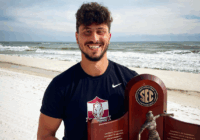
“In Italy I played for five and a half years in the Sampdoria youth academy. I started with the Esordienti and made it all the way up to the Allievi Nazionali. I was lucky to be coached by important names, like Guido Bistazzoni, people who developed some of the most talented goalkeepers in Italian soccer. They taught me a ton: at first I thought a goalkeeper just had to stand in goal and keep the other team from scoring, but there’s actually a whole world behind that position. So I fell in love with soccer even more. The only thing that wasn’t on my side was my height. I’m not very tall, at least for a goalkeeper, and that cut me out. Even though I made up for it with other skills, for example I was very good with my feet, I became the backup to Wladimiro Falcone, who is now the starter at Lecce, in Serie A. In my last two years at Sampdoria I started sitting on the bench and I was frustrated. As for school, it’s not that I wasn’t smart, I just didn’t feel much like studying after practice, I was tired and I wanted to see my friends. In fact, I had to repeat a year. Then I changed schools: I started studying graphic design and I graduated. And in my senior year I found out about YWC.“
Born in Veneto and adopted by Liguria, Francesco Zanin was developed and took his first steps in Italian soccer in one of the most prestigious youth academies in Italy, Sampdoria’s. Over the five-plus years he wore the Blucerchiati colors, his passion for soccer grew day by day, but he was held back by a height considered insufficient for a goalkeeper. The frustration of a difficult situation, however, did not stop him. Quite the opposite. And so the time came to put himself to the test again: after leaving his hometown, Venice, to move to Genoa, it was now time to seize new opportunities and build a future he had never imagined until then. It was time to look to the United States.
“The opportunity to go to a Showcase with YWC came at a time when I was a bit undecided about what to do. I went to the camp, even though I was a little hesitant, because I didn’t really know what I was getting into. After the Showcase, together with Nicolò Baudo, the founder of YWC, we put together my profile and some videos to present to the coaches. There was just one problem: my English. I wasn’t very good at speaking English, far from it, so my choice of universities would be somewhat limited. Anyway, a school in New Jersey called me: Mercer County Community College.“
From Liguria he flew to New Jersey, an East Coast state that is home to the quiet town of West Windsor, where, in addition to Mercer County Community College, there is a statue commemorating “The War of the Worlds,” the famous radio drama performed by Orson Welles that in 1938 terrified all of America by narrating an alleged alien landing on Earth in that very peaceful town, about an hour from the Atlantic Ocean. Francesco didn’t meet any aliens in New Jersey, but in the early days he couldn’t help feeling like a Martian himself.
“At first it was a bit traumatic, because going to the United States is a total change. People, places, culture: everything is different. After all, you’re on the other side of the world. And I had never been so far from home, from my family and my friends, for such a long time. At first I was scared by the idea of having to stay in America for four years, going to university and having to pass exams so I wouldn’t have problems with my student visa. And I went to the United States without knowing English: in my first weeks in New Jersey, say when I was in the dining hall, people would talk to me and I understood almost nothing. In Italy we study grammar a lot, but in America they speak a different language. I’d think: ‘What are these guys saying? Is this English, or is it a new language I have to learn from scratch?’ I was desperate. But I was lucky: I was the only Italian. So I threw myself into it, I had to be less shy to learn the language. Americans like the Italian accent anyway, and you learn English by speaking it. So, week after week, I settled in more and more.“
A language barrier is a paradoxical obstacle: the best way to break it down is precisely to talk. So, instead of closing himself off, Francesco opened up to the new world in front of him, while Mercer County Community College opened its doors wide to welcome him and give him the tools he needed to improve his English.
“After the placement test I started university, but in the first semester I only took ESL courses, English as a Second Language, classes for international students who arrive at American universities from abroad without a level of English good enough to attend the college courses that earn you the credits you need to graduate. These classes helped me get unstuck with English and improve little by little: I started watching movies and TV shows in English and, above all, making friends with my classmates and teammates. And that’s how I fit in.“
Of course, at Mercer County they also speak another language, a universal one spoken all over the planet: in Italy we call it calcio, across the ocean it’s called soccer.
“When I arrived I wasn’t expecting much, but actually, despite what people say, the level of American college soccer is rising: there’s more and more talent, also because there are more and more student-athletes coming from all over the world who have played at a high level in their home countries. They come to America and enter a system that knows how to make the most of sport, your skills and your athletic ability, but also of academics. You’re part of a college team: if you don’t have good grades or don’t pass your classes, you could be Messi or Neymar and they still won’t let you play. There’s another thing that really struck me: how the soccer calendar is organized. I thought that in the United States you played all year round, but instead you start at the end of August, with at least two weeks of preseason where you train morning and afternoon, and in October the regular season ends. If you go to Nationals, everything is over by November at the latest. I was there thinking: ‘What do I do for the rest of the year?’ Luckily, I lived in New Jersey: in less than an hour I was in New York. And Philadelphia was very close too. That’s how I spent my weekends, with friends. It was really great.“
The Vikings are the soccer team that represents Mercer County in the NJCAA, the league in which community colleges from all over America compete. A nickname, “Vikings,” that Coach Widmarc Dalce takes literally. Preseason is very tough, but Francesco makes his mark right away, becoming the starting goalkeeper for New Jersey’s green and gold.
“My first impression of the team was very positive. My coach wanted, how can I put it, to ‘prepare us like soldiers’: we had to be in shape for the season. The preseason was extremely physical and not very tactical, really different from the ones I’d done in Italy. Right from the start, though, I made a good impression on the coach and became the starting goalkeeper. On the team with me there were a lot of international players from Brazil, Spain and Mexico, and the level was really good. In fact, the first year went very well: we won the New Jersey conference and also the District, a kind of final that, if you win it, sends you to the final stage of the national championship. Unfortunately, one day before leaving for Nationals, in the last practice, I broke a finger, so I couldn’t play in the final stage, where we went out in the quarterfinals.“
Francesco needed less than a year to settle in, both in the classroom and between the posts on American soccer fields, so much so that he was named to his conference’s second team. By now he is a leader for the New Jersey college team, where in his second year he welcomed Giovanni Castagna, Tommaso Davico, Simone Liberi and Riccardo Sandulli, a group of four newcomers who came to the United States through YWC, as well as Nicolò Fasan, completing a group of six Italians who were inseparable for a year, both on and off the field.
“My second year at Mercer was different, because five Italian guys arrived: some were my friends, others I more or less knew, even if only by sight. There were six of us Italians living together in an apartment in New Jersey. It was a wonderful experience: I lived with friends, a stone’s throw from New York. The second season, on the other hand, didn’t go so well, because I broke a finger again, in the middle of the season. I was out, and we lost in the conference semifinals. Meanwhile, after taking only English courses in my first semester, from the middle of my first year and all through my second I took college courses in Business and Management, earning enough credits to transfer to a four-year university to complete a degree in Business Administration with a focus on International Business. So Nicolò Baudo of YWC helped me find a new university. And I went to Pulaski, Tennessee.“
After Mercer County Community College, Francesco’s American adventure continued at the University of Tennessee Southern, where he would pursue his studies toward a bachelor’s degree, having earned an associate degree in New Jersey, a two-year academic credential that allows you to go on and complete your studies and earn, in fact, a bachelor’s degree. The school’s team, the Firehawks, competes in the NAIA, the National Association of Intercollegiate Athletics. Compared to the NJCAA the level goes up, and he was eager to prove himself. However, settling in at Pulaski was not easy and, if anything, his relationship with his new coach, Chris Leonardi, was even more complicated.
“In Pulaski I was in the middle of nowhere. The closest city was Nashville, and that was also the main attraction. The university, on the other hand, was very nice: the campus was big and you lived in small houses on it. And we played in the NAIA, a very competitive setting. But I was only there one year, because I had some problems with the coach. I’d describe him as a somewhat over-the-top Frenchman. Yes, we had a few arguments… At first I thought: ‘I don’t want anything more to do with this, I want to go home. I’m not doing another year here.’ Then I told myself: ‘No! I want to finish my studies. And I want to do it in a place I like.’ So I started contacting various universities, regardless of the soccer level but looking at the academic level, because I wanted to keep studying something that could be useful to me in the future. Nicolò of YWC helped me put together some videos for coaches to watch, and I started emailing every coach on the West Coast: ‘I’ll keep going until I find one who answers me and makes me an offer.’ Two days later Westcliff University wrote to me. I accepted right away. And I moved. To Irvine, California.“
After his stint in Tennessee, and fourteen games played in a Firehawks jersey, Francesco moved to the West Coast, to Irvine, one of the main cities in Orange County, one of the most beautiful counties in all of California. And, after the difficult times in Pulaski, he was even more determined to continue on his academic, soccer and life journey.
“I transferred to Westcliff University in 2020, right in the middle of Covid. The university was closed, classes were online and college seasons weren’t being played. It was the start of the lockdown: you couldn’t experience college life, but everything was open, and in fact I enjoyed the California sun and beaches. But I also worked my butt off, because I managed to graduate after just a few months, even though I had started my first year taking only English courses in the first semester. At first the plan was to get my degree and go back to Italy, but I really loved California. And my coach offered me the chance to do a master’s, since all student-athletes were given an extra year of eligibility to play college soccer because of the pandemic, when the seasons had been suspended. So I stayed, for the master’s, which I finished in a couple of years, and to play. We made it all the way to the playoff semifinals.“
Westcliff University was like a fresh start: a school where he could not only finish the degree he had started in New Jersey and continued in Tennessee, earning his bachelor’s, but also begin a master’s; a team, the Warriors, where he immediately earned the trust of Coach Tom Lancaster, starting all nineteen games of one of the most successful seasons in the history of the university’s soccer program. And the first chapter of a new life in California had only just begun.
“While I was at Westcliff University I did some side jobs. One day, while I was working, I got to chatting with someone: he started asking me a few questions and I told him I came from Italy and had come to play soccer and study. He asked me: ‘What’s your major?’ I explained that I was finishing a master’s in Business Administration with a focus on international business. He asked me: ‘Would you like to come work for me?’ I answered: ‘It depends, where do you work?’ And he said: ‘I’m the vice president of Monster.’ In that moment I thought: ‘This guy is messing with me. It can’t be true.’ Anyway, he left me his number and said: ‘Come visit the company headquarters, we’ll do an interview, I’ll introduce you to the team you’d be working with and then we’ll see.’ And that’s how I ended up working for Monster while I was finishing my master’s.“
A few months before completing his master’s, Francesco had the opportunity to start a professional career at the headquarters of Monster Beverage Corporation, one of the leading beverage companies in the world. It was a year spent between a rewarding job and constant professional growth, between deadlines and commitments but also a lot of travel, and of course a few evenings and weekends spent in the California sun and sea.
“Toward the end of the year my work visa expires. I miss Italy a lot, as well as my family and friends, but I’d like to stay in the United States. My bosses are super supportive and told me they might be able to find me a position in Europe, or in Canada or South America. My goal, though, is to stay here, because I’m happy here and because working in America, at such a big company, is a once-in-a-lifetime opportunity to grow professionally. In terms of opportunities, the United States is light-years ahead, especially for people who want to work, study, challenge themselves and try to make a difference in a big organization. That’s the American mindset. I mean: my boss is 42, I work with people between 21 and 28, and one of the oldest people at the company is 35. If you’re young and you’re driven, companies value you. Maybe I was lucky, but here at Monster I’ve felt appreciated from day one. At first, when I started this job, it wasn’t easy, but my colleagues understood it was my first experience at a big company, so they were supportive and helped me. I arrived six years ago without knowing English, and now I work on the business development team of a big company. If you’re willing to work hard, in America they give you all the tools to help you find your way and achieve your goals.“
From the East Coast to the West Coast, by way of Tennessee. From the NJCAA to the NAIA, always ready to defend his teams’ goal. From a community college in New Jersey to a master’s in California, ending up working at a major company, young and dynamic. In almost seven years in the United States, Francesco has changed his life.
“What I like most about the American college system is that it lets you have a plan B. And often plan B ends up becoming your plan A, because you can build a professional career and a future. That’s what a lot of people told me at the beginning. I didn’t understand, or maybe I didn’t want to understand, but it really is like that. Most people leave because they want to play soccer, but at some point you have to realize that not everyone will make it: in the United States you play at a high level and you also have the opportunity to pursue a degree, so you don’t end up empty-handed. And having work experience in America will definitely broaden your horizons and your options for the future. Seven years have gone by since I came here, it feels like they flew by in a second, it feels like I left yesterday, but today I can see the fruits of my work. I’m proud of the path I’ve taken. And it shows that the American system works.“
By seizing the opportunity offered by YWC and completing his journey as a student-athlete, Francesco can now look to the future. And keep chasing his dreams.
“YWC is an experience that, first of all, gets you out of your comfort zone: you live through new situations and see another side of the world. And it helps you grow as a person. You set out on a path that, in my opinion, will help you face and handle situations and problems that you’d struggle more to deal with if you hadn’t had an experience like this. Of course, it’s up to each person to put in the effort during this adventure and get through the hardest moments. For me it was difficult at first, I was in a completely new world, far from family and friends, but I immediately told myself that this is an opportunity very few people get: it would have been really stupid to waste it. In the end, you have to throw yourself into everything you do. That has been my philosophy on this journey, which has now lasted almost seven years. At first it seemed crazy to leave for the United States, and now my goal is to stay. Because this is where I see my future. Then, in fifteen or twenty years, I’d like to go back and live in Italy, which is still the most beautiful country in the world. Maybe with a green card in my pocket, that would be a dream, so I could decide whether to stay here in America or go back to Italy.“
Want to follow the same path? Find out how soccer scholarships in the USA work and how to earn one with YWC.
Article by Niki Figus