“I’ve always been obsessed with soccer, ever since I was little, ever since I was four or five years old playing in the backyard. I’ve always had this passion. I came up through the youth teams of the club in my town: it doesn’t exist anymore, it’s now called Clivense, since Sergio Pellissier took it over. I spent a few years at Sanbonifacese and Virtus Verona, then I went back to Clivense, which back then was called San Martino Speme. I played youth and juniores, then I moved up to the first team. I played a few games in Eccellenza, then I dropped down to Promozione, and later, when I was working, I went to Prima Categoria. And then I left for the United States.“
Michele Forapan has one great passion: soccer. Born in Verona in 1999, he has been playing on the fields of his home region, Veneto, since he was a kid. His present is split between work, college and the ever-present ball. His future, on the other hand, is the United States.
“I chose to go with YWC because at that point, besides playing, I was working and studying at university, Sports Science applied to soccer. I had heard about the opportunity to go to America to study and play soccer, and I had talked about it with a friend who had been offered a scholarship. I told myself: ‘Interesting! It could be a good experience… Why not try?’ I went on the website to learn more and, of course, I talked about it with my parents, who told me: ‘We’re not putting any limits on you. If it’s something you like, go for it.’ So I decided: ‘I’ll try, I’ll take the leap.’ I did the tryout in January 2020, right before Covid broke out. I went to the Showcase in Milan, and Yannick Bright was also there for the two days. I liked the environment, and Nicolò Baudo, the founder of YWC, made a good impression on me right away. He explained the project and told me: ‘Look, there’s this opportunity. We can now put you in touch with some colleges, if you really want to start this project.’ I decided to go, and then, as fate would have it, Covid hit, which of course slowed the whole process down a bit. But I was convinced: ‘I want to go, I want to have this experience.’ By January 2021 I had all my paperwork ready. And in March I left.“
From Veneto to the United States. From tiny San Briccio, a village of about a thousand people just outside Verona, to Lima, Ohio. Waiting for him is a student-athlete journey at the University of Northwestern Ohio, where he would study and wear the jersey of the Racers, the soccer team of UNOH, a college with almost four thousand students who come not only from all over America, but from all over the world.
“In Italy I lived in a small town near Verona, with just a thousand residents. It was a very quiet place and, in general, I’ve always liked being in the middle of nowhere: I can’t stand big cities. Before leaving for Ohio I had looked up where the college was, and the town had 35,000 people: it really was a very quiet place. In fact, when I got there I felt right at home. Even though, of course, at first it was a little strange. I knew English, or rather, I understood it, but I struggled a bit to speak it, because when I talked with others I thought of the words in Italian and translated them into English in my head… I was a bit clunky. Still, it wasn’t hard to fit in, partly because the college was a very international environment: my teammates came from all over the world, so they either were, or had been, in the same situation as me. In any case, I never felt left out; on the contrary, we joked about it sometimes and, anyway, everyone made me feel at home. Basically, right from the start I had a second family: today my best friends come from every part of the world. Lucas, my best friend, who was my first roommate, is Argentinian: we talk every day. After Lucas graduated, I had another roommate, Bjarne, a German guy: he also became one of my best friends. It’s an experience that lets you build bonds that stay with you. UNOH was really great, partly because you spent almost all your time with the others on campus, since there wasn’t much around, unlike other places. On campus there were housing complexes with two floors: eight people lived on the first floor and another eight on the second; there were two of us in each room, each with its own bathroom, and the apartments had plenty of space and everything you could need. We lived in a sort of ‘little village,’ also because in these apartments we were divided by sport: I was with all my teammates, and to see each other you just had to take one step out of my room’s door… It was really great. Living all together lets you get to know new cultures and helps you understand different points of view. It makes you grow.“
It doesn’t take Michele long to settle into his new life at the University of Northwestern Ohio, partly because the setting around the campus reminds him, in some ways, of his childhood town. What is very different, however, is the daily routine, since life as a student-athlete in America is very different from that of a soccer player who is also a university student in Italy.
“My daily life was basically this: wake up, go to class and then go to practice in the afternoon. Then, starting from my second year, I began working after practice, from 5:00 to 10:00 p.m. It was pretty demanding, but I still really enjoyed it. Compared to Italy, I think college in America is a bit easier, but the big difference is that in college every one or two weeks you have to turn in an assignment, a paper or an essay, which the professor checks so that you’re prepared for the exam. In Italy you ‘manage yourself’ and, for example, you can choose to do nothing for a month and then spend the next two studying, while in America every two weeks you have to write a paper or an essay to prepare for the final exam. The other big difference, of course, is that in the United States you have the chance to play a sport… In fact, it’s precisely through sport that you can study, thanks to a scholarship. In Italy, instead, they are two separate worlds: if your practice hours and your class hours overlap, you have to choose between studying and playing soccer. In America it’s not like that, and you can make sport and college work together.“
It doesn’t take long to adjust to the world of American soccer either. Although some differences are definitely hard to get used to.
“Soccer-wise, the experience was very positive, partly because the team was strong and the level was very competitive. And there were some players who could have made a difference in Italy too. What was different was that in America we were all young, while in Italy, at that level, players of all different ages played together. Another big difference is that American soccer is extremely physical. And the preseason kills you. My preseason was three practices a day: at 6 in the morning, at 3 in the afternoon and at 6 in the evening. I wanted to shoot myself: I’d wake up at 5:15, 5:30 in the morning, because I basically lived next to the field, and as soon as my roommate heard the alarm he wanted to throw my phone out the window. I hated preseason, also because in the summer it gets really hot in Ohio, up to 30 to 35 degrees Celsius, while in the winter it got as low as -20 degrees.“
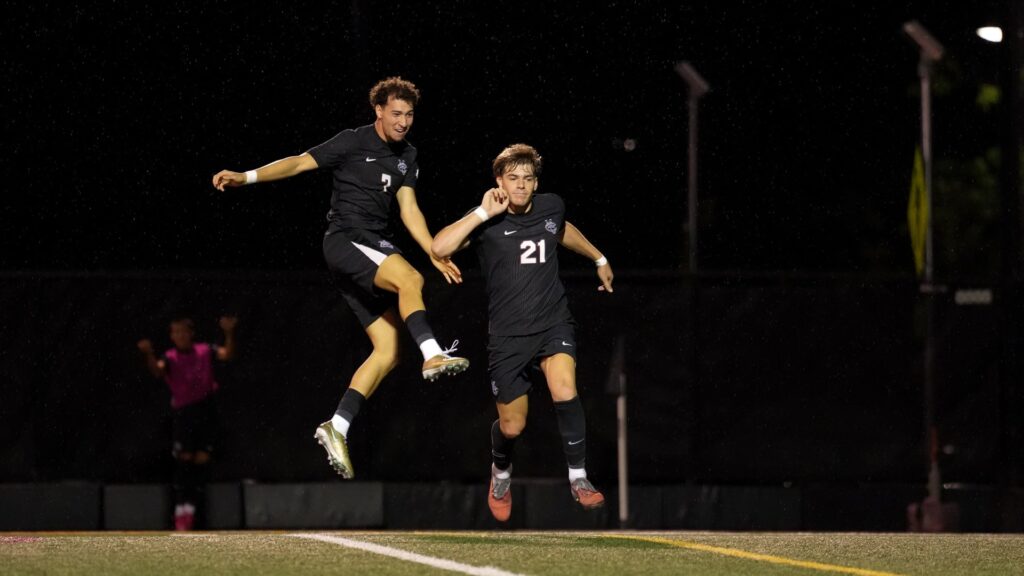
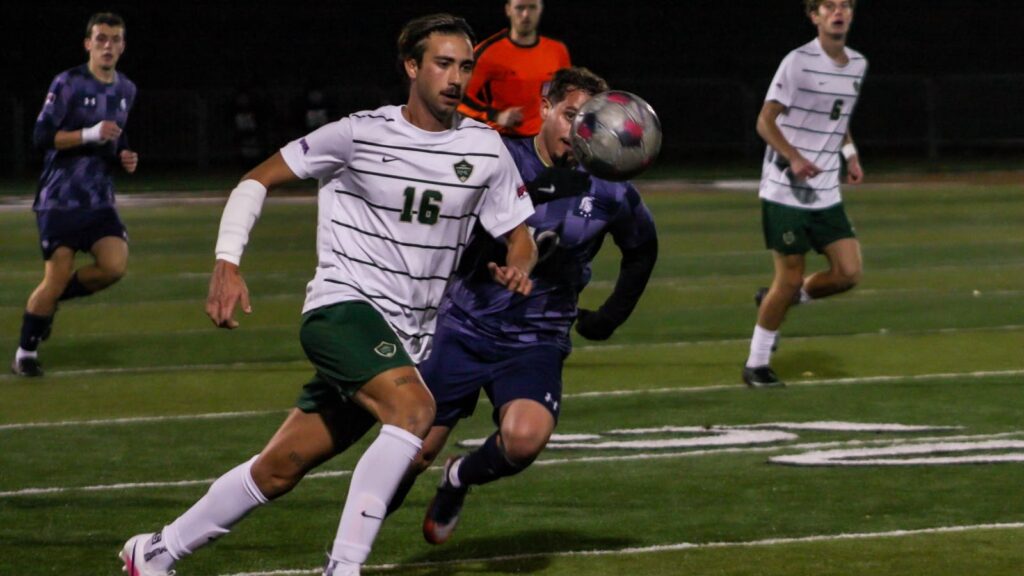
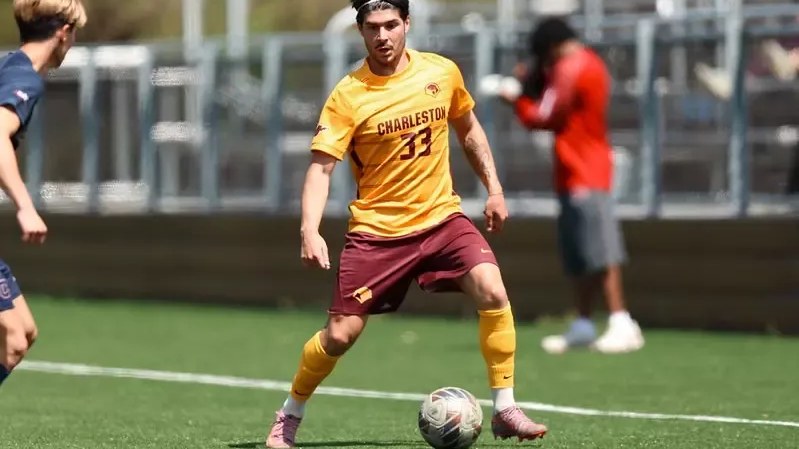
Over four seasons played across three years, due in part to the 2020 season being postponed because of the pandemic, Michele Forapan, wearing the Racers’ number 12 jersey, made 43 appearances, with one goal and one assist. From the very beginning, he is a reference point for the maroon-and-gray midfield and for all his teammates. Thanks to the competitiveness and tactical vision that define his game, he helps make the Ohio side one of the most feared teams in the Wolverine-Hoosier Athletic Conference, one of the most competitive regional conferences in the NAIA, the National Association of Intercollegiate Athletics, a national college soccer circuit. The Racers are consistently among the top teams in their conference and, therefore, in the nation; however, the UNOH team always falls just short of completing what Americans call “the last mile.”
“Basically, we always finished second. We were the eternal runners-up… Our conference was tough, but we still went to Nationals every single year. In my second-to-last season we made it to the final stage of the tournament and went out in the second round, losing to Bethel University, which went on to win the championship.“
Having brilliantly completed his student-athlete experience at the University of Northwestern Ohio, both on the field and in the classroom, Michele intends to stay in the world of soccer, leaving the field to take a seat on the bench, while still remaining in his new home, the United States.
“I graduated a year early, because I took more courses than my study plan required. After graduation, my goal was to become a soccer coach, so I decided to stay in the United States, because the only way to keep coaching full-time without doing other jobs was to stay in America.“
Soccer, both playing and coaching, is his passion. And the United States, as everyone knows, is “the land of opportunity“: with hard work, a passion can become a life path.
“Soccer has always been my passion. I’ve always loved playing, but at some point I said enough: I didn’t really feel like it anymore. But I’ve always had the idea of becoming a coach. I played central midfielder, and I liked studying players’ movements and opposing teams’ tactics, while during practice I always paid attention to what we were doing, how we could improve, what movements we could make. Really, it’s something I’ve always had inside me, since I was a little kid. I always tried to help my teammates… I’d tell them: ‘Try to do this, try to do that.’ Basically, as I grew up, coaching became more exciting than playing. Even back in Italy I coached the kids at the clubs where I played: it was an experience that helped me be patient and understand how to behave, it helped me understand how to approach players and how to adapt different training sessions. In the United States too I took part in a few summer camps as an assistant coach. My coach in Ohio, Coach Tyler Brock, always took me with him: he’s highly respected in the NAIA world, so in the summer he always had a lot of opportunities, and I always followed him. The coach and I had a great relationship right from the start. When I left for the United States I was already twenty, so from day one I was among the ‘oldest’ players on the Racers. And Coach Brock wanted ‘mature’ people who would help their teammates settle in. He always saw me as a leader, and so did the team: even though I wasn’t the captain, a lot of teammates came to me for help and we talked about different situations on the field. And Coach Tyler Brock too, not that he asked me for help, but every now and then he’d say: ‘What do you think about this? We could try this other thing…’ I’ve always loved coaching: before, I saw it more as a hobby, but since I got here to America I’ve started to see it as a career.“
Before graduating, Michele starts looking for a job in the United States. The goal is to work as a coach in the world of soccer.
“In April 2023 I started looking for work. I told myself: ‘I’m graduating in November. I need to get moving, I need to start looking for something.’ Right away I looked for an opportunity to become a coach here in America. And I had an idea: ‘Let’s see if there’s an Italian academy in the United States.’ I looked, and at the time there was only an Inter Academy in Boston. As it happens, I’m an Inter fan… I sent my résumé, they liked it, and within a couple of weeks they got back to me. They were about to open a coaching position, right before I contacted them: it was an absurd coincidence. And then, as luck would have it, the academy director had graduated from my same university, the University of Northwestern Ohio. Not only that: his roommate was Coach Kedar Roderick, my assistant coach at UNOH. Incredible! Coach Roderick put in a good word, and in the summer I went to Boston for the summer camp to see how they worked. That’s where it all started. In November I got in the car, drove twelve hours from Ohio to Boston, and in January 2024 I started working there.“
A passion, or rather two, for soccer and for Inter, thus becomes his new job: Michele Forapan is now Head Soccer Coach of Inter Academy MetroWest Boston, a soccer school in the heart of Massachusetts affiliated with the Nerazzurri club.
“Right now I’m working as a coach at the Inter Academy in Boston. We started with six teams about two and a half years ago, and now we have ten, with kids born between 2011 and 2016 who play in a local league. It’s a demanding job and it takes a lot of sacrifice, because you’re busy from morning to night, but I love it, so it doesn’t weigh on me too much. The Academy has a sponsorship agreement with Inter, which, in addition to providing the name and logo, sends a coach to the United States for six months a year to oversee the work being done. Our goal now is to expand, reaching sixteen teams by September 2024. Some academies, after twenty years, have gotten to as many as three hundred teams: that’s the level we’re aiming for. Also because soccer in America is growing in popularity and more and more families are choosing soccer for their kids.“
The United States proves, once again, to be the land of opportunity. And even more so for those looking for a future in the world of soccer.
“I’ve never thought about going back to Italy, absolutely not, because if I went back I couldn’t do what I want to do, what I’m doing now. I’m really happy here and there are so many opportunities. In America soccer is exploding: in the last four years, since I’ve been here, the game has grown, there’s more and more investment in Major League Soccer and some big-name players have come here to play. Soccer still has a lot of room to grow in the United States. And in the coming years there will be a real boom: the Copa América is coming up soon, next year the Club World Cup, and in 2026 the World Cup. I’ll just throw it out there: within thirty years, in my opinion, the U.S. national team will have a chance to win a World Cup. Either way, for us coaches, the possibilities and opportunities will keep growing.“
Coach Michele Forapan’s present is the Inter Academy in Boston. As for the future, the goal is to keep working and eventually take the helm of a college soccer team.
“For now I want to keep doing my job here at the Inter Academy and help this club grow. I’d love for the Boston Academy to become well known enough to be a reference point for Inter in Milan as well: some academies based abroad get invited to Italy for trips, and I’d like to give our kids that opportunity. Looking further ahead, I’d love to become the coach of a university team. That’s my goal, although right now, of course, it’s right that I keep gaining experience.“
After a soccer career in Italy, in the Verona area, and by seizing the opportunity that came with YWC, Michele has built a present for himself in the United States, living a student-athlete experience that allowed him to turn his greatest passion, soccer, into a job by becoming a coach. And it’s only the beginning of a new chapter in his life.
“YWC is an experience I recommend, because it opened a lot of doors for me. If I had stayed in Italy, living a ‘normal’ life, so to speak, I never would have had certain job opportunities, I never could have built the connections that one day might bring me new opportunities, even in other parts of the world, and I never would have had the chance to meet different people and cultures.“
Want to follow the same path? Find out how soccer scholarships in the USA work and how to earn one with YWC.
Article by Niki Figus